Beech trees stand out in any landscape, recognizable by their smooth gray bark, shiny leaves, and spiky beech nuts. Beech species in Massachusetts include the American beech, which is native to the eastern US and provides food for wildlife, and the European beech, which was introduced as a landscape tree and is valued for its elegant structure and dense foliage. These majestic trees can live for hundreds of years, but beech trees throughout the eastern United States are rapidly declining due to Beech Leaf Disease.
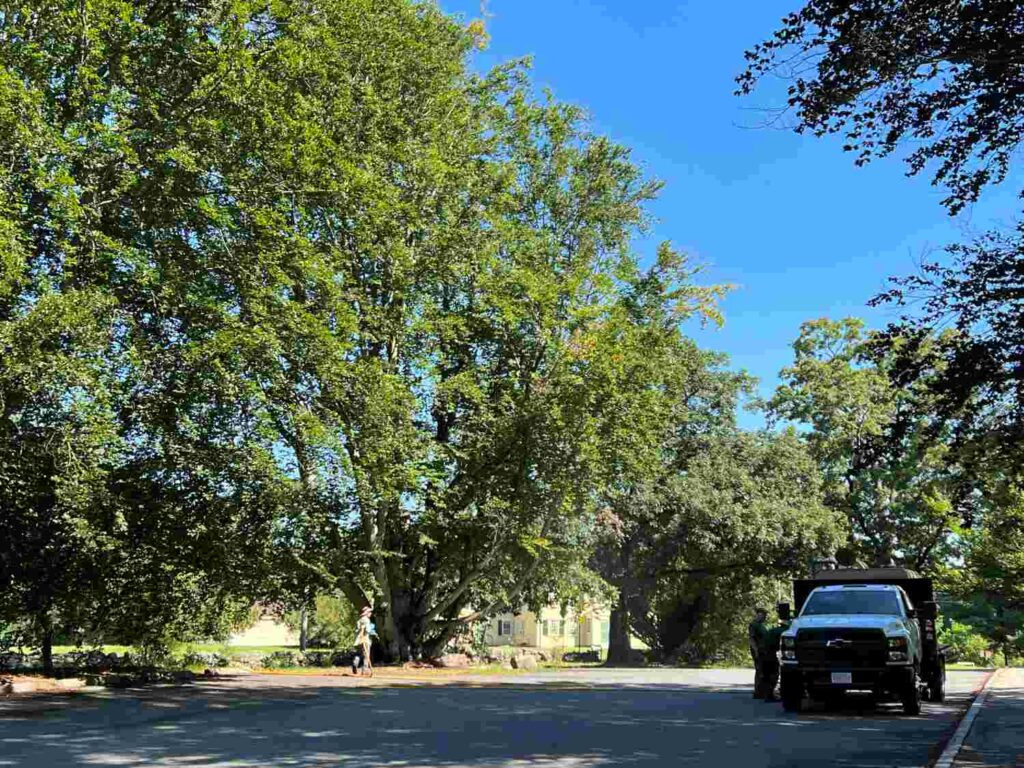
At Minute Man National Historical Park, mature European beech trees surround the North Bridge Visitor Center parking lot and lawn area. These beeches, planted by the Buttrick family over 100 years ago, are an important part of the park’s cultural landscape but are being impacted by Beech Leaf Disease.
Beech Leaf Disease (BLD), which spread to Massachusetts in 2020, is caused by a nematode (a microscopic worm) that lives in the buds and leaves of beech trees. BLD nematodes spend their winters in beech leaf buds, feeding on bud tissue and laying eggs. When the buds expand into leaves in the spring, the nematodes travel through the leaf tissue and continue to grow their population until late summer, when they migrate back to newly formed buds to hide out for the fall and winter.
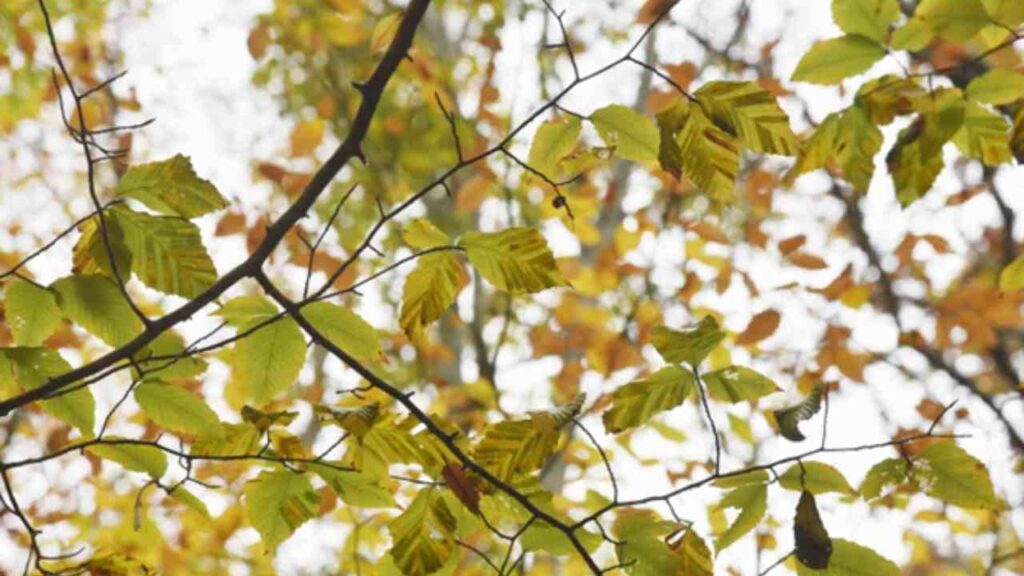
BLD nematodes damage the bud tissue, creating thick layers of cells in the developing leaves. This appears on the leaves as dark green bands and causes leaves to grow crinkled and leathery. Over time, the loss of buds and leaves causes canopy thinning. With less leaf area for photosynthesis, this leads to overall tree decline and eventual death as there aren’t enough healthy leaves left to support the tree.
Research for BLD is ongoing, and currently there is no known treatment that would get rid of the nematode entirely. We can, however, take actions to improve tree health and mitigate the impacts of BLD to extend the lifespan of infected beech trees. At the North Bridge Visitor Center, the beeches have been treated annually since 2023 with Broadform, a foliar spray to reduce nematode populations. Other treatment options include root flare injections to apply chemical directly into the trunk, which travel throughout the internal system of the tree, phosphite applications to strengthen the tree’s natural defenses, mulching exposed roots to reintroduce nutrients to the soil, and reducing foot traffic under the tree canopy to minimize soil compaction.
We’ll continue working to keep our beech trees healthy at Minute Man for as long as we can!
Written by Sophie Gronbeck, Minute Man National Historical Park Resource Management Associate
Photos Courtesy of the NPS. Above, a tree affected by Beech Leaf Disease. Below, beech trees near the North Bridge Visitor Center.
Support Minute Man National Historical Park by becoming a member of the Friends today!